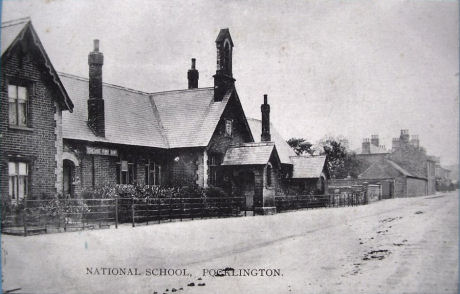
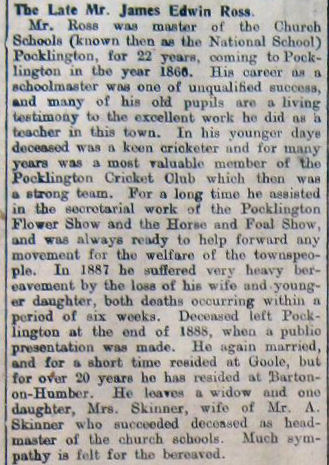
Pocklington’s first National School was built in 1819 on West Green. The National Society, founded in 1812, had as its aim ”to communicate to the poor generally, by means of a summary mode of education lately brought into practice, such knowledge and habits as are sufficient to guide them through life in their proper stations, especially to teach them the doctrine of Religion, according to the principles of the Established Church.” Since Pocklington was, according to the 1851 Religious Census, a stronghold of Methodism it is hardly surprising that Robert Dennison, the Lord of the Manor, built the National School and that it was 'very liberally supported by the gentry in the town'. In 1823 the average number of scholars was said to be 75 boys and 60 girls. The school is listed in Easton’s Directory of 1845. It was demolished when the railway was built in the 1840s and replaced by a new school in New Street in 1854 at a cost of £1,440 (including the site) with John Heppinstall the first master for boys, girls and infants, followed by Henry Heppinstall who was master in an 1857 directory, but had left by 1858 when a trade directory said there was 'No Master'. In the 1861 census, James Hill Age 27 was the National School Master. In the 1871 Census James Edwin Ross was National Schoolmaster, and he arrived in 1866 and left in 1888, when Atkinson Skinner took over. Atkinson Skinner was master until 1923.
|
The National School in New Street
(built by Thomas Grant) |
| A directory of 1879 records that ‘the National schools for 100 boys, 60 girls, and 100 infants, together with a house for the master, were erected in 1854 at a cost of (including the value of the site) upwards of £1,400: of this sum the Committee of Council paid £631, and the National Society contributed £60; the site was presented by the Ecclesiastical Commissioners (lately holders of land in the parish), and Admiral the Hon. Arthur Duncombe, their lessee.’ Admiral Duncombe was then Lord of the Manor. In 1913 it was listed as the Church of England School, New Street, (mixed & infants), average attendance, 150 boys &girls & 56 infants. By the 1960s it was solely for infants. The school was closed in the 1970s and was replaced by Pocklington (C of E) Infant School in Maxwell Road.The building was later used as the Pocklington Youth Centre. |
|
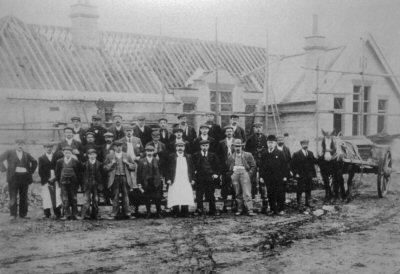
Thomas Grant built the
C of E Council School in Kirkland Street
(Thomas Grant is thought to be the man in the apron, Charles Duncombe the man with the light suit with Thomas Robson representing the council to his left) |
The County Council School in Kirkland Street, opened in February, 1908, was built at a cost of about £3,000, for 250 scholars, including infants, William Lamb, was the master.
An additional class room added in 1910, built at a cost of about £3,000, taking the capacity up to 290 scholars, including infants average attendance, 147 mixed & 80 infants: William Lamb, master; Miss Amy Allanson, infants' mistress
|
|
Howdenshire Chronicle and Pocklington Weekly News
13th March 1915 |
| Atkinson Skinner married the daughter of James Edwin Ross and was headmaster of Pocklington Church Schools from 1888 to 1923. His diary survives in the Treasure House at Beverley (zDDX389/1) and parts of it have been reproduced on this website. He was master of Barnetby le Wold Boys' School Apr 1882-Dec 1885, master of Huggate National School 1886-1887, master of Pocklington (Mixed) National School 1888-Mar 1923; and died 27 Jan 1942. |
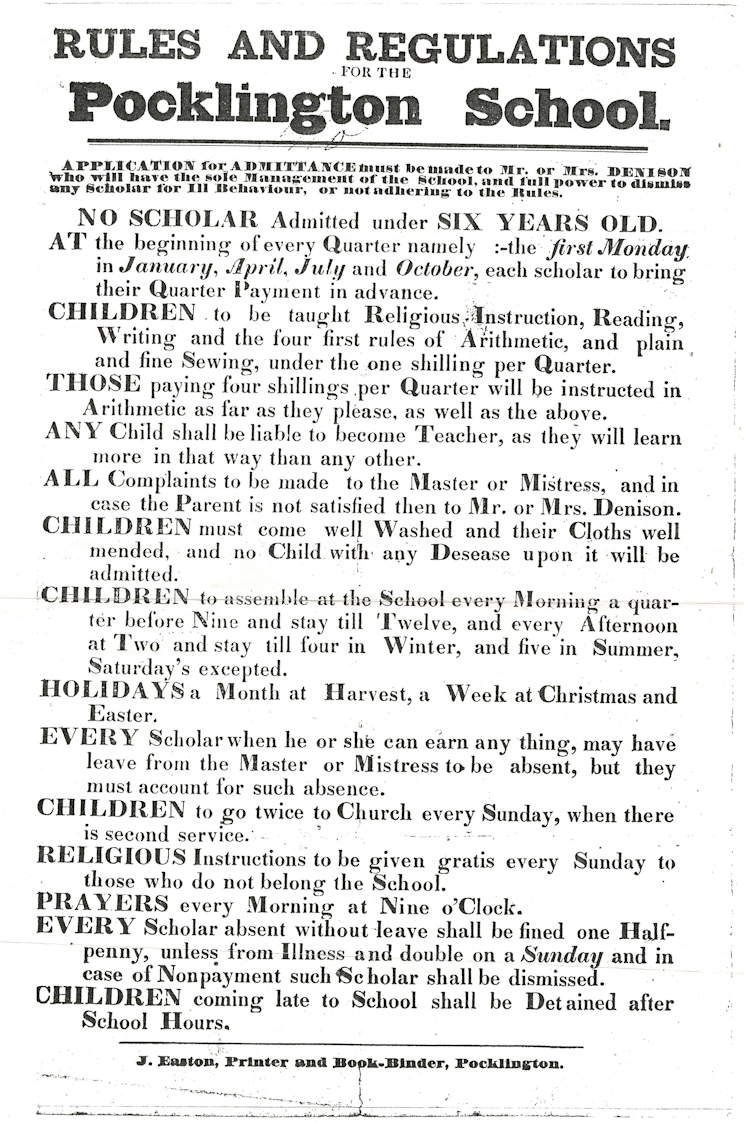 |
| This poster would be prior to 1850 when Mr Denison's National School was down West Green. Poster emerged thanks to the estate of the late Rober Bellingham. |
|
|