 |
|
|
|
|
|
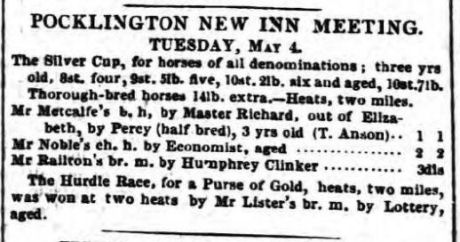
| Pocklington had a race track which went around the perimeter of the New Inn. The autobiography of George Boast the jockey, who was born in Pocklington in 1786, is an interesting insight into early horse racing. The following account appeared in The Racing Times, for February 15th, 1858. Pocklington produced many notable and prominent Jockeys of the 18th & 19th Centuries, including John Singleton born in 1715, one of the countries first leading Jockeys, Simeon Templemen was another prominant jockey who won the Derby. The New Inn racecourse was operating at least up to May 1842 as is shown by the cutting at the bottom of this page. Races were held from at least 1783 (see the remarkable picture of the 'Pocklington Plate' trophy at the bottom of this page). |
|

George Boast was the son of a Pocklington butcher whose first job as a young boy was for Pocklington publican and racetrack owner, Mr Timothy Overend junior, at the New Inn, Pocklington.
His first race was around 1796 in Pocklington's May race meeting on the track that surrounded the New Inn. Boast went on to be a stable lad at Middleham, then Newmarket, where he looked after the Prince of Wales' horses.
His ambition was always to be a jockey, and though he never won any major races he raced at southern meetings for a few years, including riding 'Orange Boy' in the 1837 Derby. Another local jockey and future double Derby winner, Simeon Templeman, from Burnby, rode in the same race.
A brief Biography of him appears in "RACEHORSE TRAINING AT EPSOM" By BILL EACOTT
(
ISBN 978-0-9548278-1-6)
"George Boast was born in Pocklington, Yorkshire one of thirteen children; and his riding career commenced riding ponies in races around the New Inn in his native village. He moved on to racing stables at Malton, Middleham, and then to Newmarket where he worked in the stables of the Prince of Wales. Boast was riding Mr. Stirling’s horses trained by James Balchinin 1838, and rode Orange Boy in the Derby that year. The York Herald in 1839 lists him as training three horses for Mr. Stirling at Epsom, he was still training for M. Stirling in 1841, notably running Clarendon for Mr. Stirling at the the Hippodrome racecourse at Bayswater. By 1851 he was a farrier based at Marlborough."
|
|
|
|
Clipping taken from: Bell's Life in London and Sporting Chronicle
Sunday May 08 1842 |
|
|
| |
|
|
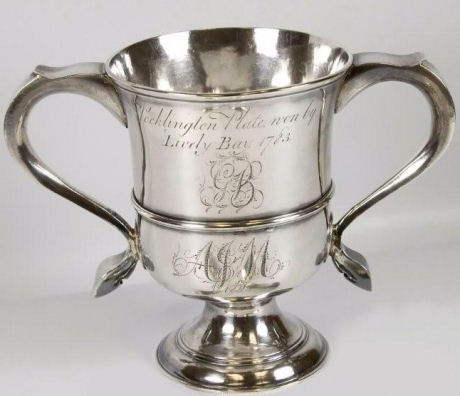
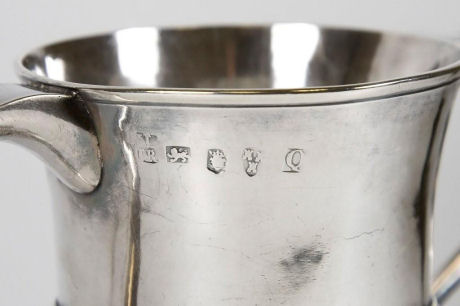
This remarkable trophy is in the USA in private possession of a descendant of the winning owner (or possibly Jockey). The inscription reads 'Pocklington Plate won by Lively Bay 1783'. The initials GB, refers to Gideon Burton of Aughton near Selby, who was presented with the trophy. It also has the initials 'AJM' which are thought to have been added in 1894 by Gideon's grandson, Aaron John Mosey, whose family emigrated from Ellerton to the USA in the 1850s.
This trophy is likely to be one of the annual silver cups from the Pocklington racecourse at the New Inn. It also proves that Pocklington races were held as far back as 1783, and the hall marks perfectly match the 1783 date. The Maker's mark (Langlands & Robertson), lion passant, leopard's head w/crown,
Newcastle stamp, and date letter Q. (no sovereign's head; thought to have
started in 1784.) The date letter "Q" is thought to be for the time period May 1782-May 1783. The maker's mark is IL. A reference book on "Old English Plate" says John Langlands (Senior) and
John Robertson became partners in 1778. In 1795 John Langlands (Junior)
became partners with John Robertson (replacing his father John Langlands Sr). These two remained together only until 1795.
Thanks to Emily McBride of the USA for the above information and photographs (via Denise Mosey of Kirkella, whose husband is the 3x Great Grandson of Gideon Burton). |
| |
|
|
|