 |
|
|
|
|
| Earl Morcar of Pocklington? |
|
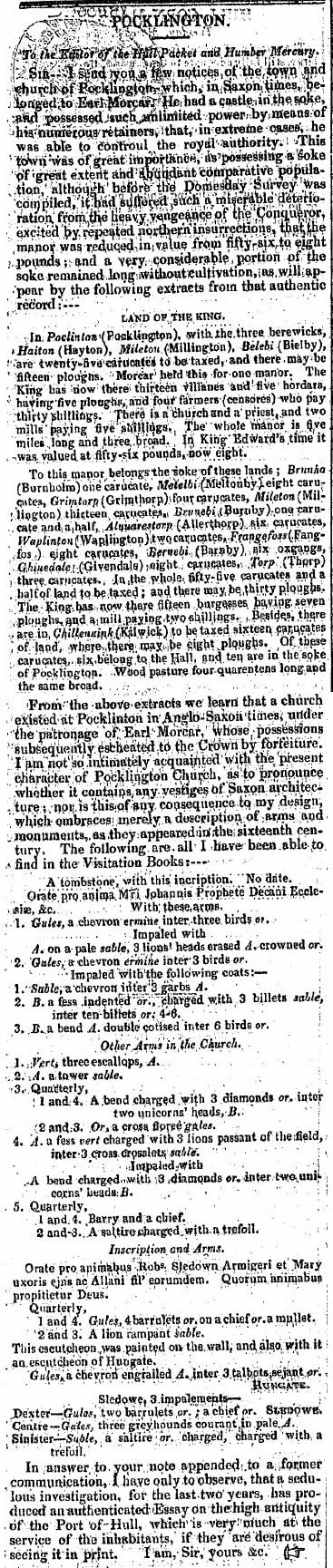
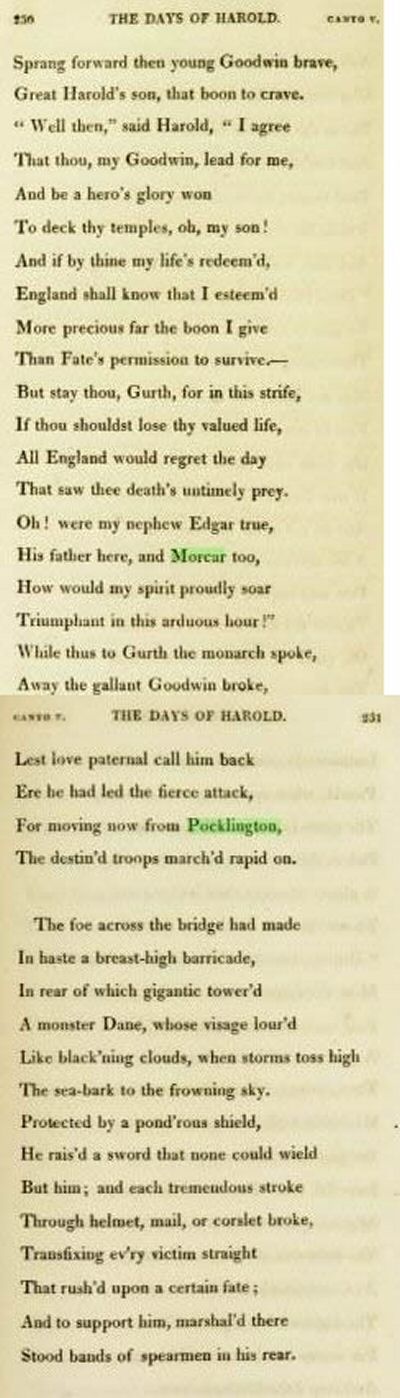
Did Earl Morcar have a castle in or near Pocklington? His home is thought to be at Casterton near Stamford in Lincolnshire. Earl Morcar fought with his brother Edwin against the viking invaders of Harold Hardrada and the treacherous brother of King Harold, Earl Tostig. However, Morcar was defeated at Fulford in 1066 . It is thought that after the defeat, Morcar could have pulled back to Pocklington and awaited Harold's army to arrive. In pursuit of Morcar, the Vikings took the route to Pocklington via Stamford Bridge, which was the only crossing point of the Derwent at that time*. Two slender pieces of evidence have emerged in support of this. An early letter to the 'Hull Packet' newspaper on March 15th 1831, and the discovery of an old poem in a book called "The Days of Harold" published in 1816 by John Benjamin Rogers, which describes Morcar marching his troops from Pocklington to the Bridge (Stamford). Was 'Tute Hill', near the church, the site of the early castle of Earl Morcar mentioned in the letter?
* There may have been an early crossing at Sutton on Derwent and it is possible that there had been a wooden bridge at Kexby at the time of the Norman Conqest but there was, according to the VCH, a ferry there before the stone bridge was built in the late 1420s.See the article on Turnpike's by Roger Bellingham. |
|
|
An early letter to the 'Hull Packet' newspaper on March 15th 1831 |
|
An old poem in a book called "The Days of Harold"
published in 1816 by John Benjamin Rogers |
|
|
|