|
Neave states that Flaxdressers were brought from Belfast and other centres of the flax industry and It flourished until in 1856 a serious fire destroyed the flax stacks which stood between the station and the cemetery:
Neave quotes an un-referenced newspaper source:
"The fire commenced about midnight on Wednesday the 5th February 1856 and raged fearfully until about 12 o'clock noon the following day, but was not extinguished until the Friday following. The number of stacks consumed being ten and a half and their measurement being 12 yards long 6 wide and 12 high and containing from 70 to 80 tons each stack, and each stack valued at £800 and the whole insured for £8,000. The fire engines were in attendance from York, but only £40 worth of flax wax saved by the exertions of those who witnessed the fire. Reports slated that the fire was seen at York, Normanton, Doncaster and Sheffield and anyone could see the time by their watches a distance of seven or eight miles away."
Neave goes on to relate that there was apparently some mismanagement in the affairs of the flax factory, the fire only adding to its troubles and though the mill was still in existence in 1859 it was closed soon afterwards. The site was sold to Thomas Grant and the great factory chimney was pulled down.
A newspaper report from the York Herald of 9th February, 1856 has a report of the fire:
"GREAT FIRE AT POCKLINGTON.
IMMENSE DESTRUCTION OF PROPERTY.
A fire of a most terrific character, involving the loss of an immense amount of
property, and such as has perhaps never been seen at Pocklington before—even by the
oldest inhabitant"—occurred at that town on the night of Tuesday last.
It may be known to many of our readers that in the year 1852, R. Denison, Esq , of
Waplington Manor, about two miles and a half from Pocklington, commenced a flax mill at
the East end of the town. He had previously used the premises as a tannery. The flax
mill covers more than three acres of ground, and it is thought that Mr. Denison is now
carrying on the most extensive business of this description in England. He employs
about 200 hands, and for the information of the uninitiated, it may be as well to
observe that at this mill the processes of steeping and scutching the flax are carried
on, preparatory to its being placed in the hands of the spinners. In order to carry
this out on the extensive scale that we have indicated, a quantity of steam power is
brought into exercise besides the manual labour to which we have referred. As all the
flax required could not be kept at the mill, it was of course necessary that a separate
piece of ground should be appropriated for stacking the flax as it was received. The
field or stack garth which has been employed is about seventy yards from the York and
Market Weighton branch of the North-Eastern Railway, and not much further from the end
of the Pocklington station. Immediately opposite the field, and close to the line of
railway is a large brick shed or depot which, on Tuesday nighty contained upwards of
250 quarters of all kinds of grain. A footpath nearly surrounds the field, and leads
from the town to what is called the River Head. The stacks stood near the foot-road,
and were not very far from Pocklington Grammar School. The number of them amounted to
ten, and there was a portion of another. To give some idea of their size, we may state,
as we are informed, that they were twelve yards long by six broad, and twelve yards in
height. They contained from seventy to eighty tons of flax, and a few of them even more. They have been valued at from £800 to £900 each,
and, with the exception or one, they contained all the finest flax grown last year. The
exception was a stack of flax grown the year before. Six or seven of these stacks were
placed in a row next to the foot road to which we have already alluded, and the
remainder were behind them, all being near to each other.
This property, of so valuable a description, appeared all safe on Tuesday night, and
the inhabitants of Pocklington were certainly not prepared to witness so appalling a
conflagration as met their gaze when aroused from their beds. Mr. Hall, glover, who
resides in the marketplace, was the first person to discover the fire. Having to attend
a cow near calving, in the Black Swan Yard, he went out of his front door at twenty
minutes past twelve o'clock on Wednesday morning, and seeing light across the Red Lion
public-house, and towards the railway station, he said to his son who was with him that
he thought there was a chimney on fire. The son, however, thought the light
proceeded from the stackyard of Mr. Denison, and he ran in that direction to see if his
suspicion was well founded. He was followed by his father, and they discoverd that
some of the stacks were in a blaze. In a short time they saw fire proceeding from the
bottom of the second stack nearest the station, and the broad Side of the third stack
was all in flames. Mr. Hall and his son immediately aroused Mr. Milner, the station
master, and a person, who resides at the coal depot. They then went down the
principal street and gave the alarm, the church bells were rung, and this unusual
noise, together with, the cries of "Fire !" produced no little sensation, and caused
most of the inhabitants to rush to the scene of the fire. It was astonishing to
witness the manner in which the flames spread from stack to stack, it being compared by
persons who were witnesses of the circumstance to the rapid progress of a train of
gunpowder. No doubt the spectators were terror-striken aud paralysed at first, but
they endeavoured to save some portion of the flax. They placed some tarpauling over a
few of the stacks, but the flames were so fierce as speedily to ignite and consume both the tarpauling and the ladders which had been employed in this praiseworthy
service. About an hour after its first discovery, the fire had communicated to
the whole of the stacks, which presented one broad and overpowering mass of flame,
creating anxious fears for the safety of the shed near the station and other property
in the, immediate locality,more especially as a fresh breeze had sprung up. The wind
was in the South or South-West, and burning masses of flax were carried towards, and to
a distance of a quarter of a mile beyond, the town. Two or three of the old
thatched houses were ignited, but as persons were keeping a proper look out, very
little injury was occassioned in this way, the fire being immediately extinguished.
Some notion may be formed of the fearful glare of the fire-which, in the language of
some present was "awfully grand" - from the fact that the reflection it caused was
distinctly seen in Hull, York and Doncaster. In fact, such was the certainty felt that
there was a fire somewhere that notice was given to Mr. Taylor, the superintenent of
the fire brigade, employed by the Yorkshire Insurance Company, at the St. Andrewgate
station, before two o'clock. Had he been aware of the locality much more service might
have been rendered by the engines than actually occurred. Mr. Taylor, however, got out
of bed, and looking out of the window distinctly saw the reflection which the fire
produced, the morning being very dark. Mr. Robert Hotham, the agent for Mr. Denison,
and superintendent constable Cordukes arrived at the stack yard about one o'clock, and
it may be mentioned that for convenience of unloading the trucks as they arrive by
railway, branch lines are laid into the field. A loaded track had been left near the
stacks, and both the flax upon it and the wood work were entirely consumed, nothing
being left of it but the wheels and the other portions of iron of which a truck is
composed. Owing to a quantity of burning materials being carried over the town, it was
feared that the the mill might be endangered, but we understand Mr. Boyd, the manager,
took precaution to station a number of the workmen on the roof for the purpose of
throwing water upon it, and so as to avoid tbe possibility of the works being set on
fire.
A small useless engine, about eighty years old, is kept at Pocklington, and
consequently there was no other alternative than to send to York for the engines.
Probably from some misunderstanding, the messenger, we hear, did not leave Pocklington
until alter two o'clock on Wednesday morning, and he arrived in this city in a gig.
Perhaps, under the circumstances, it would have been better if a horseman had been
sent, and a person who knew where to find the fire engine station. As it was, the
messenger, apparently having no such knowledge, proceeded to the railway station, and
consequently Mr. Taylor did not receive the necessary information until ten minutes
before four o'clook. He, however, from the previous intimation that had been given him,
was ready for action, and after post-horses had been obtained, an engine was taken from
the St. Andrewgate station to Pocklington, where it arrived about half-past five o'clock. A second engine from the Newstreet
station was dispatched, and was at the fire about three quarters of an hour after the
former one. Besides Mr- Taylor, there were present a number of firemen from York, and
Mr. Dent, their foreman. Such was the glare created by the dunes flames that most of
the road was illuminated, and a person seven or eight miles off could tell the hour by
his watch. A good supply of water was obtained from the beck, which is about 300 yards from where the engines were placed and although a large body of water was poured on
the burning mass, the fire was not got under till eight or nine o'clock and was not
completely extinguished until evening when the engines returned home.
A portion of the stacks was nearly burnt to the ground when the engines arrived, and
the heat was so extensive that it is surprising how the railway shed was preserved.
Timely precautions, however, were taken and men were stationed inside ready to render
every assistance, if required. Had there been a similar hurricane that prevailed the
night following, it is felt that not only was it likely that the building in question
but many others in the town would have fallen prey to the flames, though happily a
greater calamity than that which took place has been averted. Nearly the whole of the
flax was destroyed, and as the seed it contains is of an oily nature, this would add
fierceness to the fire. It is calculated that about 1,000 quarters of linseed have been
destroyed along with the fibre. The damage thus sustained it is, of course, impossible
for us exactly to estimate, but it is thought it amounts from £8,000 to £10,000 Mr.
Denison is insured to the extent of £8,000. viz. £5,000 in the Imperial, and £3,000 in
the Yorkshire Insurance Company; and whether Mr. Denison will sustain any loss beyond
this we are not prepared to say.
What renders this fire the mere painful is that there is every reason to believe it has
been the diabolical work of an incendiary, or from some person carelessly smoking a
pipe, though, from the hour of the night, such a suposition can hardly be entertained.
It could not arise from spontaneous combustion, and it will be remarkedthat the flames were observed to proceed from the bottom of one or two of the stacks.
We understand that James Catton, a private watchman, had been in the direction of the
stacks about twelve o'clock, and he did not see any fire about them then. It is to be
hoped whoever the guilty party may be, he will soon be brought to justice. It was
rumoured that two Irishmen, who had been in Mr. Denison's employ, had been apprehended
of the charge of setting fire to the stacks. This report, however, as we hear, is
entirely without foundation, Mr. Denison not having had any unpleasantness with his
work people, and none of his hands having been paid off. We believe also that no person
in- particular has been suspected of the serious crime which it is thought has been
perpetrated.
It is fortunate that none of the persons in Mr. Denison's employ will be thrown out of
employment by this catastrophe, they being kept at work as the flax arrives from the
farmers, and it is probable that that will continue to be the case until the new crop
comes in."
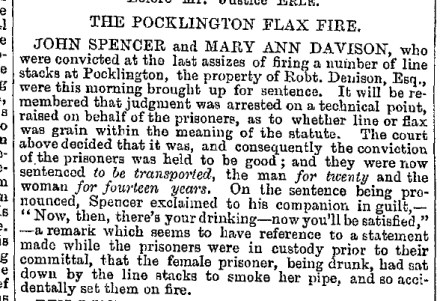
The culprits John Spencer and Mary Ann Davison were found and prosecuted and transported to Australia for the crime. It seems it was started by a drunk Mary Ann Davison who had sat down by the stacks to smoke her pipe and had accidentally set them on fire.
|
From the Leeds Mercury, December 13, 1856 |
|
The Yorkshire Gazette of 23rd May, 1857 |
|
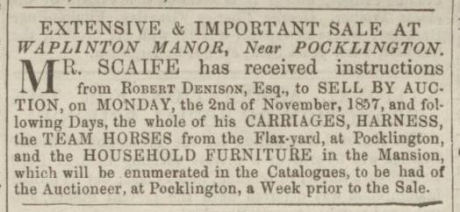
Yorkshire Gazette - Saturday 17 October 1857
The flax stacks fire of 1856 had disasterous financial consequences
for Robert Denison
Image © THE BRITISH LIBRARY BOARD. ALL RIGHTS RESERVED. |
|
Yorkshire Gazette - Monday 7th Sept 1861
Image © THE BRITISH LIBRARY BOARD. ALL RIGHTS RESERVED.
Source:http://www.britishnewspaperarchive.co.uk/viewer/bl/0000266/18611007/101/0007 Image reproduced with kind permission of http://www.thebritishnewspaperarchive.com/
|
|
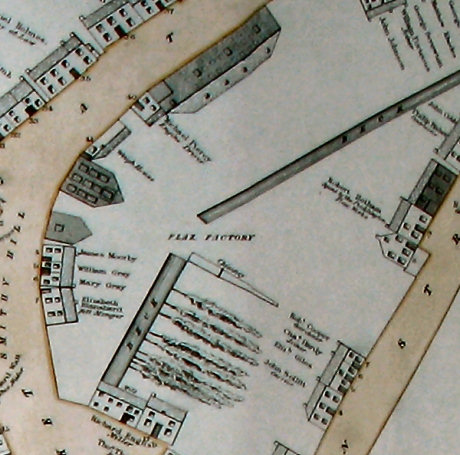
In 1855 Willam Watson shows the location of the Flax Factory |
|
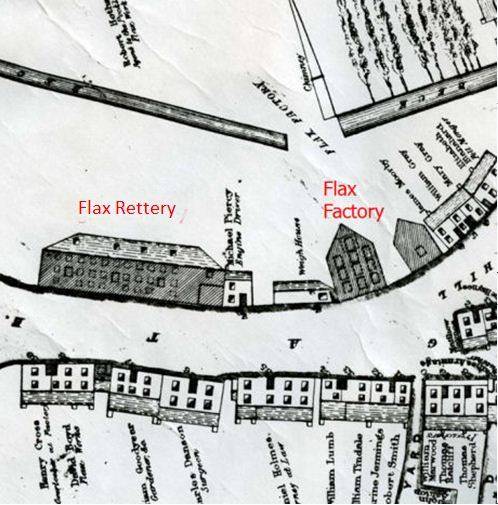
The Flax Rettery was a very substantial 3 story building on the
1855 Watson map and must have been newly built as it does not appear on the 1854 OS map below. The newspaper sale report above is dated 1857 and says "it was recently erected in the most substantial manner" |
|
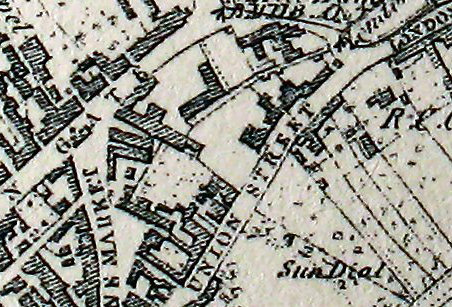
The 1854 OS map shows the building layout but does not show the substantial 3 story Flax Rettery that must have been built after the map was drawn |
|
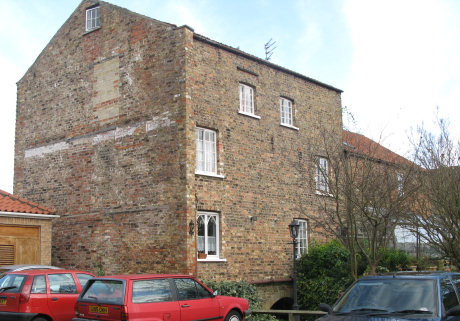
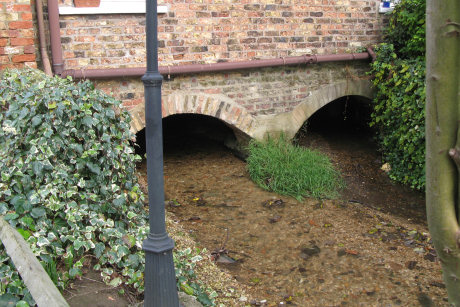
One part of the old buildings still survives today.
The outline of connecting doors are visible to a much bigger building, as shown on the 1854 OS map. |
|
The beck still flows under the building |
|
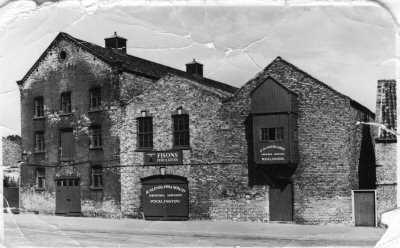
This photograph, taken between the wars, shows the old Victoria Hall (left) built in 1896 by Thomas Grant to replace the grain store of RM English (previously the flax rettery) which caught fire in 1896. It was built to the same size and specification of the previous building. Victoria Hall later reverted back to RM English. See the maps below which shows the outline of the buildings. |
|
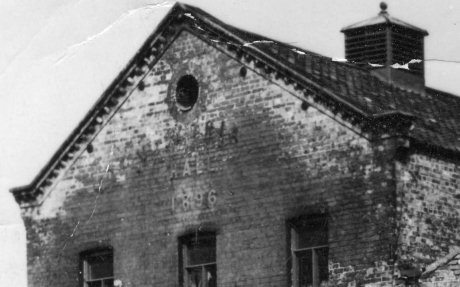
At the top of the Building says "Victoria Hall 1896" |
|
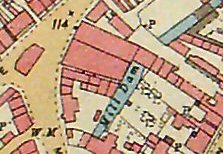
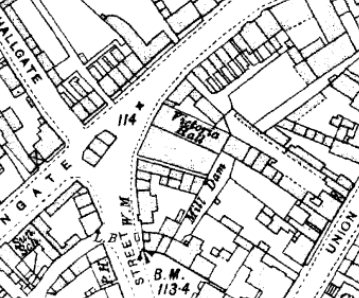
1891 OS Map - RM English Grain Store,
clearly attached to the building over the beck |
|
1911 OS Map showing Victoria Hall |
| In the York Herald for March 8th 1862: On Saturday afternoon last, a youth sixteen years of age, named John Sellars, whilst assisting to take down a wall at the flax mill, sustained a compound fracture of the right leg. He was conveyed to the York Country Hospital, where he is doing well. |
Flax has been grown in the Pocklington area from early times, possibly even as early as Roman times. Certainly, the mediaeval period have records of many linen weavers in the town. Thomas Holderness in his publication "Some place-names of the east riding of Yorkshire, a paper", 1881, suggests that the local place names of Waplington and Pocklington might derive their names from the fact of lin (flax) having been grown there. |
| |
To: The General Board of Health.
Date: 20th November 1855
From: F J Gruggan, Headmaster of the Grammar School, Pocklington [Yorkshire].
Letter advising that the inhabitants of Pocklington have been suffering from episodes of smallpox and typhus and suggesting that a large establishment for the steeping of flax, situated in the centre of the town, may be the cause of such outbreaks. The air in Pocklington is described as 'continually most foul' due to the water flowing from the steeping pits, which is said to run through the middle of the town affecting many of its wells. He seeks guidance from the General Board as to the possible application of The Health of Towns Act [Public Health Act 1848] at Pocklington.
Source: https://discovery.nationalarchives.gov.uk/details/r/C14391434
Ref: MH 13/234/35 - The National Archives |
|






.JPG)
.JPG)